
Introduction
Many small medical practices are losing thousands of dollars in Medicare reimbursements each month—not because they lack eligible patients, but because their billing systems have not evolved alongside the services they already provide.
Programs such as chronic care management, remote patient monitoring, and annual wellness visits are already recognized by CMS and offer predictable, recurring revenue streams. These services do not require practices to increase patient volume or extend working hours. Instead, they rely on properly capturing, documenting, and billing the work that is already being performed.
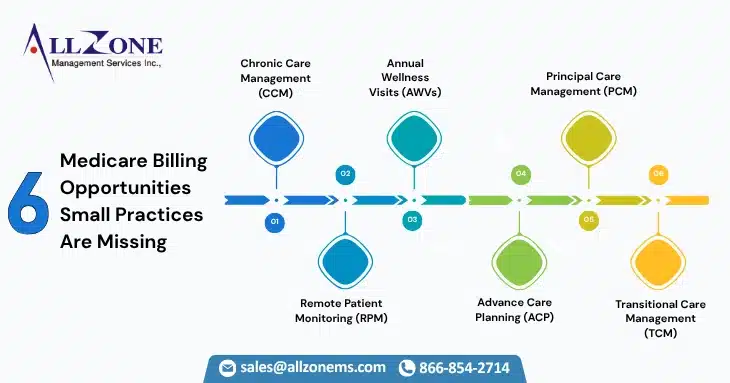
For practices aiming to improve revenue without increasing operational burden, these six billing opportunities represent a practical starting point. According to the Centers for Medicare & Medicaid Services (CMS), programs like CCM, RPM, and TCM are designed to improve patient outcomes while ensuring providers are fairly reimbursed.
Key Takeaways
-
- Many services are already being performed but not billed correctly
- Proper documentation and workflow optimization are critical
- Combining programs (like CCM + RPM) can significantly increase revenue
- Even a small patient base can generate substantial recurring income
What Are the Top Medicare Billing Opportunities?
| Service | Revenue Potential | Key Benefit | |
| CCM | $62–$154/month | Recurring chronic care revenue | |
| RPM | $110–$140/month | Remote monitoring income | |
| AWV | $128–$163/visit | Preventive care billing | |
| ACP | Varies | Billable care discussions | |
| PCM | ~$83/month | Single-condition management | |
| TCM | $201–$272 | Post-discharge care revenue | |
1. Chronic Care Management (CCM)
Chronic Care Management applies to Medicare patients with two or more chronic conditions, making it a highly relevant service for many primary care practices.
Key CPT Codes
-
- 99490 – First 20 minutes of non-complex CCM
- 99439 – Each additional 20 minutes (up to twice monthly)
Revenue Potential
-
- ~$62.69 for the first 20 minutes
- ~$107.16 for 40 minutes
- ~$154.60 for 60 minutes
Even a small group of eligible patients can significantly impact revenue. For example, failing to bill CCM for just 10 patients monthly may result in over $12,000 in lost annual revenue.
Most of the work required for CCM—such as care coordination, patient communication, and chronic condition monitoring—is already being performed by clinical staff. However, the missed opportunity often comes from not tracking time accurately and not submitting the appropriate codes.
Requirements
- Initial face-to-face visit
- Patient consent (verbal or written)
- Comprehensive electronic care plan
2. Remote Patient Monitoring (RPM)
Remote Patient Monitoring has transitioned from a pandemic-era solution into a long-term revenue contributor for practices.
Key CPT Codes
-
- 99453 – Device setup and patient education
- 99454 – Monthly device supply and data collection
- 99457 – First 20 minutes of monitoring
- 99458 – Additional 20 minutes
Revenue Potential
-
- $110–$140 per patient/month
- Over $1,000 annually per patient
RPM can represent a meaningful portion of Medicare revenue, especially for practices that consistently monitor patients.
RPM becomes even more valuable when combined with CCM. While both programs can be billed together, each requires separate documentation and time tracking. The inability to double-count time is a key compliance requirement, meaning practices must maintain clear and independent records for each service.
3. Annual Wellness Visits (AWVs)
Annual Wellness Visits are fully covered by Medicare, with no copay, coinsurance, or deductible, yet they remain underutilized.
Key HCPCS Codes
-
- G0438 – Initial visit
- G0439 – Subsequent visits
Reimbursement
-
- ~$163 for initial visits
- ~$128 for follow-ups
A common issue in billing AWVs is incorrect code usage. The initial visit code (G0438) reimburses significantly more than the subsequent visit code (G0439). Using the wrong code can lead to avoidable revenue loss.
In 2025, CMS expanded the G2211 add-on code, increasing reimbursement for initial visits when applied correctly. AWVs can also be billed alongside evaluation and management services using modifier –25, further enhancing revenue potential.
4. Advance Care Planning (ACP)
Advance Care Planning has been billable under Medicare since 2016, yet adoption remains low among providers.
Key CPT Codes
-
- 99497 – First 30 minutes
- 99498 – Additional 30 minutes
Requirements
-
- Minimum of 16 minutes documented
- Face-to-face discussion with patient, family, or surrogate
These conversations often occur naturally during patient visits, especially during wellness visits or routine care discussions. However, the gap arises because providers frequently do not document the time spent or fail to submit the appropriate codes.
When ACP is provided during an Annual Wellness Visit and billed correctly with the appropriate modifier, patients typically incur no out-of-pocket costs, making it easier to integrate into routine care.
5. Principal Care Management (PCM)
Principal Care Management is designed for patients with a single high-risk chronic condition, distinguishing it from CCM.
Key CPT Codes
-
- 99424, 99425 – Physician services
- 99426, 99427 – Clinical staff services
Revenue Potential
-
- ~$83.40 per patient/month for initial 30 minutes
PCM is particularly useful for managing patients at high risk of hospitalization or functional decline. While CCM requires multiple conditions, PCM allows providers to focus on a single condition that demands intensive management.
A key billing rule is that PCM and CCM cannot be billed together for the same patient in the same month. However, different providers can bill separately if they are managing different aspects of care.
Recent updates have expanded PCM billing access to rural health clinics and federally qualified health centers, increasing its applicability.
6. Transitional Care Management (TCM)
Transitional Care Management focuses on patients transitioning from inpatient care to home or community settings.
Key CPT Codes
-
- 99495 – Moderate complexity (~$201.20)
- 99496 – High complexity (~$272.68)
Billing Requirements
-
- Patient contact within 2 business days of discharge
- Face-to-face visit within:
- 14 days (moderate complexity)
- 7 days (high complexity)
- Documented medical decision-making
The biggest challenge with TCM is not clinical—it is operational. Practices often lack systems to track hospital discharges in real time or to ensure timely follow-up.
However, when workflows are properly established, TCM not only generates revenue but also helps reduce 30-day readmissions, which can have financial implications under CMS policies.
Quick Comparison Table: Medicare Revenue Opportunities
| Service | Key Codes | Revenue Potential | Key Requirement |
| CCM | 99490, 99439 | $62–$154/month | 2+ chronic conditions |
| RPM | 99453–99458 | $110–$140/month | Device + monitoring |
| AWV | G0438, G0439 | $128–$189/visit | Preventive visit |
| ACP | 99497, 99498 | Varies | 16+ min discussion |
| PCM | 99424–99427 | ~$83/month | 1 high-risk condition |
| TCM | 99495, 99496 | $201–$272 | Post-discharge care |
Conclusion
Optimizing Medicare billing is one of the fastest ways to improve financial performance in a small practice. By leveraging these six opportunities, providers can unlock consistent, scalable revenue while improving patient care outcomes.
Small practices don’t need more patients or longer hours to grow revenue—they need better utilization of existing medical billing opportunities.
Courtesy: Physicians practice
Stop Losing Money on Medicare Claims
Get personalized support from Allzone’s coding experts to reduce denials and improve reimbursements. Submit the form below, and our team will connect with you shortly.