
Introduction
ICD-10 compliance is critical for healthcare organizations to ensure accurate billing, minimize claim denials, and maintain regulatory standards. However, many practices face recurring challenges that compromise coding accuracy.
In this article, we’ll explore the top 10 common ICD-10 compliance issues in medical coding, their impacts, and practical solutions to help you stay compliant and efficient.
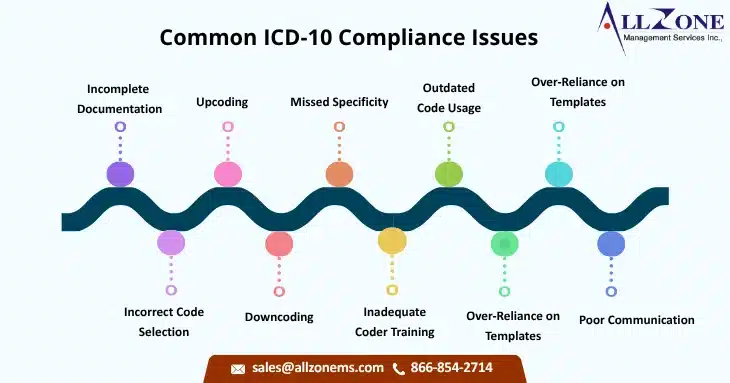
What are the most common ICD-10 compliance issues in medical coding?
- Incomplete documentation
- Incorrect code selection
- Upcoding and downcoding
- Missed specificity
- Outdated code usage
- Inadequate coder training
- Poor communication between coders and clinicians
Top 10 ICD-10 Compliance Issues & Their Impact
| # | Issue | Description | Potential Impact | Solution/Best Practice |
| 1 | Incomplete Documentation | Missing clinical details | Claim denials; payment delays | Educate clinicians; use checklists |
| 2 | Incorrect Code Selection | Wrong ICD-10 codes used | Billing errors; compliance risk | Use updated codebooks; double-check |
| 3 | Upcoding | Coding for higher severity than warranted | Audits; penalties | Regular audits; coder education |
| 4 | Downcoding | Coding for lower severity than warranted | Lost revenue | Training; audit reviews |
| 5 | Missed Specificity | Lack of detail in coding | Denials; reduced reimbursement | More precise documentation |
| 6 | Inadequate Coder Training | Coders not updated on ICD-10 changes | Errors; compliance issues | Ongoing education; certification |
| 7 | Outdated Code Usage | Using obsolete codes | Claims rejection | Regular codebook updates |
| 8 | Over-Reliance on Templates | Generic templates lacking detail | Missed clinical nuances | Customize and update templates |
| 9 | Inconsistent Coding Practices | Lack of uniform coding standards | Data integrity issues | Standardize policies; peer review |
| 10 | Poor Communication | Insufficient coder-clinician interaction | Misunderstandings; coding errors | Encourage collaboration |
1. Incomplete Documentation
Problem:
Coders depend on provider documentation for accurate code assignment. When documentation is incomplete—missing laterality, severity, underlying causes, or procedure details—coders are forced to make assumptions or choose less specific codes.
Impact:
- High rate of claim denials or requests for additional information.
- Delayed or reduced reimbursement.
- Increased audit risk and compliance concerns.
Solutions:
- Provider Training: Conduct regular training sessions for physicians and clinical staff on documentation requirements for ICD-10 codes.
- Documentation Checklists: Implement checklists or EMR prompts to remind clinicians to include all necessary details.
- Feedback Loops: Create a system for coders to query providers when documentation is unclear or insufficient.
Example:
A claim for pneumonia without documentation of whether it is bacterial, viral, or aspiration may be denied or reimbursed at a lower rate.
2. Incorrect Code Selection
Problem:
Selecting the wrong code, whether due to typos, misunderstanding, or reliance on outdated resources, is a frequent issue. The specificity and expanded options in ICD-10 make it easy to pick an inaccurate code.
Impact:
-
- Billing discrepancies and compliance risks.
- Increased possibility of payer audits.
- Patient medical records may be inaccurate.
Solutions:
-
- Updated Codebooks: Ensure all coding resources are updated annually with the latest ICD-10 revisions.
- Coder Training: Regularly train coding staff on new guidelines and code updates.
- Double-Check Protocols: Implement peer review processes, especially for complex or high-value claims.
Example:
Confusing “Type 1” and “Type 2” diabetes codes can lead to improper billing and misrepresentation of patient history.
3. Upcoding
Problem:
Upcoding occurs when codes for more severe or complex diagnoses or procedures are used when not supported by the patient’s documentation. While sometimes unintentional, this can be seen as fraudulent and is heavily penalized by payers.
Impact:
-
- Triggers payer audits and recoupment of overpayments.
- Legal or financial penalties.
- Damages provider reputation and trust.
Solutions:
-
- Routine Audits: Regular internal or external audits to detect upcoding patterns.
- Coder Education: Focus on the risks and legal consequences of upcoding.
- Clear Policies: Establish clear compliance guidelines and zero-tolerance policies.
Example:
Billing for a complex wound repair when the documentation only supports a simple suture.
4. Downcoding
Problem:
Downcoding is the opposite of upcoding: selecting a less severe or less expensive code than what is supported. This often happens due to fear of audits, lack of documentation, or coder uncertainty.
Impact:
-
- Reduced reimbursement and lost revenue.
- Skewed clinical data affecting quality reporting.
- Potential compliance risks if patterns are detected.
Solutions:
-
- Documentation Improvement: Enhance clinical documentation to capture the true extent of care provided.
- Coder Support: Offer regular feedback and encourage coders to query providers for missing information.
- Audit Reviews: Identify and address patterns of downcoding.
Example:
Reporting a regular office visit instead of a comprehensive evaluation due to missing documentation details.
5. Missed Specificity
Problem:
ICD-10 codes require a high level of specificity (e.g., laterality, episode of care, anatomical site). Missed specificity often results from incomplete records or selection of generic codes.
Impact:
-
- Claims are denied or reimbursed at lower rates.
- Loss of valuable clinical data for analytics and reporting.
- Increased administrative burden.
Solutions:
-
- Specificity Training: Emphasize the importance of detail during coder and provider training.
- EMR Prompts: Use electronic health record prompts to capture necessary code details.
- Regular Audits: Review claims for missed specificity and provide targeted feedback.
Example:
Coding “fracture of arm” rather than specifying “closed fracture of right humerus, initial encounter.”
6. Inadequate Coder Training
Problem:
ICD-10 is complex, and code sets are updated regularly. Coders who lack ongoing training or credentials are prone to errors.
Impact:
-
- Increased coding errors and compliance violations.
- Higher rates of claim denials and resubmissions.
- Lower staff morale and job satisfaction.
Solutions:
-
- Ongoing Education: Invest in continuous education and coder certification (e.g., CPC, CCS).
- Workshops & Webinars: Encourage attendance at industry conferences and online training.
- Mentorship Programs: Pair less experienced coders with seasoned professionals.
Example:
A coder unaware of annual ICD-10 updates continues using deleted codes, leading to claim rejections.
7. Outdated Code Usage
Problem:
ICD-10 codes change annually. Using obsolete or retired codes is a common reason for claim rejections.
Impact:
-
- Claims are denied outright by payers.
- Increased administrative workload in correcting and resubmitting claims.
- Delayed cash flow.
Solutions:
-
- Annual Codebook Updates: Replace printed and digital codebooks every year.
- EMR/Practice Management Updates: Ensure software vendors push regular ICD-10 updates.
- Awareness Campaigns: Notify staff of code changes and highlight commonly updated codes.
Example:
Submitting a claim with a code deleted in the most recent ICD-10 update.
8. Over-Reliance on Templates
Problem:
Electronic health record (EHR) templates speed up documentation but can result in generic, copy-pasted, or incomplete records that lack individualized detail.
Impact:
-
- Potential for noncompliant, inaccurate, or “cloned” documentation.
- Missed clinical nuances affecting compliance and care quality.
- Higher risk of audit findings.
Solutions:
-
- Template Customization: Tailor templates for different specialties and conditions.
- Periodic Review: Regularly audit template usage and make necessary updates.
- Provider Training: Educate providers on the risks of overusing templates and encourage adding patient-specific details.
Example:
A template auto-fills “left knee pain” for every orthopedic patient, even when the issue is in the right knee.
9. Inconsistent Coding Practices
Problem:
When coding standards vary among team members or across departments, inconsistency leads to unreliable data and compliance headaches.
Impact:
-
- Compromised data integrity and analytics.
- Increased risk of payer audits.
- Difficulty in meeting reporting requirements (e.g., HEDIS, MACRA).
Solutions:
-
- Standardized Guidelines: Develop and enforce organization-wide coding policies.
- Peer Reviews: Conduct regular inter-coder audits and case reviews.
- Centralized Training: Provide unified training sessions for all coding staff.
Example:
Two coders assign different ICD-10 codes for the same clinical scenario, resulting in inconsistent billing and reporting.
10. Poor Communication between Coders & Clinicians
Problem:
Lack of open communication or feedback between coders and clinical staff means documentation gaps go unaddressed, and errors persist.
Impact:
- Increased chance of coding errors and claim denials.
- Frustration on both sides, impeding workflow.
- Missed opportunities for documentation improvement.
Solutions:
-
- Regular Meetings: Establish scheduled discussions between coding and clinical teams.
- Query Systems: Implement a formal process for coders to request clarifications.
- Documentation Improvement Programs: Involve clinicians in ongoing documentation quality initiatives.
Example:
A coder is unsure whether a procedure was performed during an inpatient or outpatient stay, but there is no process to clarify quickly.
Practical Tips to Improve ICD-10 Compliance
-
- Invest in coder education and certification: Empower staff with up-to-date knowledge and credentials.
- Use up-to-date coding resources: Replace codebooks and update EMRs annually.
- Standardize documentation and coding protocols: Consistency reduces errors and audit risk.
- Encourage coder-provider collaboration: Open communication leads to better documentation and coding accuracy.
- Conduct regular internal and external audits: Identify patterns, provide feedback, and correct issues before payers or regulators do.
FAQs: ICD-10 Medical Coding Compliance
Why is ICD-10 compliance so important in medical coding?
ICD-10 compliance ensures accurate reimbursement, reduces claim denials, and protects healthcare organizations from audits, penalties, and reputational harm. It also supports high-quality patient care and robust clinical data for reporting and analytics.
How can coder errors be minimized?
Through ongoing coder education, use of updated resources, regular audits, and standardized coding policies, organizations can greatly reduce coding errors and compliance risks.
What are the consequences of upcoding or downcoding?
Upcoding can trigger audits, financial penalties, and legal action due to overbilling. Downcoding leads to lost revenue and may also raise compliance concerns if it appears systematic.
How often should coding audits be performed?
At a minimum, quarterly. High-volume practices or those experiencing frequent denials should conduct audits more frequently. Regular audits help catch and correct errors before they become systemic.
What’s the best way to stay current with ICD-10 updates?
Subscribe to industry newsletters (e.g., AHIMA, AAPC), attend webinars and workshops, work with vendors to ensure timely software updates, and replace codebooks annually.
Conclusion
ICD-10 compliance is a vital part of every healthcare organization’s coding and billing process. The risks of noncompliance—such as inaccurate reimbursement, audits, and penalties—are too significant to ignore.
By proactively addressing these top 10 compliance issues, investing in continuous education, and strengthening communication between coders and clinicians, organizations can significantly reduce claim denials and improve overall efficiency.
Partnering with Allzone, a leading medical coding company, enables healthcare providers to enhance coding accuracy, streamline processes, optimize revenue, and deliver consistent, high-quality patient care.
Ready to improve your ICD-10 compliance?
Contact our experts or explore our resources for training, audits, and ongoing support today!