
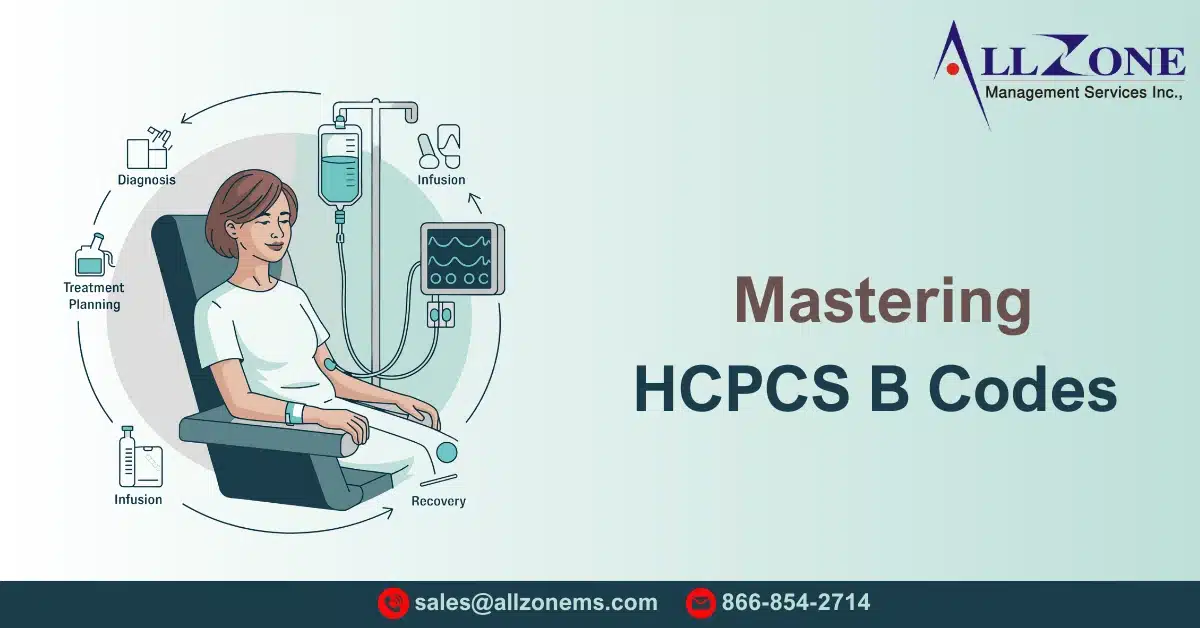
Enteral and parenteral therapies play a critical role in the treatment of patients who cannot meet their nutritional or medication needs through normal oral intake. From patients with gastrointestinal disorders to those requiring long-term intravenous nutrition, these therapies are essential for sustaining life and improving clinical outcomes. However, billing for these services can be complex, especially when it comes to correct usage of HCPCS B codes.
For healthcare providers and billing teams, understanding HCPCS B Codes for enteral and parenteral therapy is vital to ensure accurate reimbursement, compliance, and reduced claim denials. In this Allzone blog, we break down what HCPCS B codes are, how they apply to enteral and parenteral therapy, common billing challenges, and best practices for error-free medical billing.
Understanding HCPCS B Codes in Medical Billing
The Healthcare Common Procedure Coding System (HCPCS) is divided into Level I (CPT codes) and Level II codes. HCPCS Level II codes, identified by a single letter followed by four numbers, are used primarily to describe supplies, durable medical equipment (DME), non-physician services, and injectable drugs not included in CPT.
HCPCS B codes are the specific identifiers for enteral and parenteral nutrition formulas, the supplies needed, and the various components of related therapies. These codes are the standard for billing nutritional and infusion therapies administered outside of a hospital, and they’re used by Medicare, Medicaid, and private insurers alike.
Using HCPCS B codes correctly is key. It ensures that healthcare providers get paid fairly for the specialized nutritional support they offer, all while staying within the rules set by the payers.
What exactly is enteral therapy, and how do HCPCS B codes fit in?
Enteral therapy delivers nutrients straight into the gastrointestinal tract. This is done through feeding tubes like nasogastric (NG), gastrostomy (G-tube), or jejunostomy (J-tube). It’s a common treatment for patients who can’t swallow or absorb nutrients properly, but whose GI tracts are still working.
HCPCS B codes for enteral nutrition cover:
-
- Enteral feeding formulas
- Feeding supplies
- Equipment used for tube feeding
For example, specific HCPCS B codes identify nutritionally complete formulas, specialty formulas for disease-specific needs, and administration supplies.The precise assignment of these codes hinges on considerations including the patient’s diagnosis, the method of administration, and the substantiation of medical necessity.
Inaccurate pairing of the appropriate HCPCS B code with the corresponding clinical documentation frequently leads to claim rejections or payment delays.
Parenteral therapy, encompassing Total Parenteral Nutrition (TPN) and Peripheral Parenteral Nutrition (PPN), circumvents the digestive tract, delivering nutrients directly into the circulatory system via intravenous access. This therapeutic approach is generally employed when the gastrointestinal tract is either nonfunctional or presents contraindications.
HCPCS B codes pertinent to parenteral therapy encompass:
-
- Parenteral nutrition solutions
- Amino acids, dextrose, and lipid emulsions
- Infusion-related supplies
Billing for parenteral therapy is more complex than for enteral therapy, mainly because of strict medical necessity rules, documentation requirements, and specific rules from different payers. For example, Medicare requires detailed physician orders, complete records of nutrient composition, and proof that enteral nutrition isn’t suitable.
Documentation Requirements for HCPCS B Codes
A common reason for denials related to HCPCS B codes is insufficient or incomplete documentation. To support claims for enteral and parenteral therapy, providers must keep thorough records, including:
-
- Physician orders that specify the type and length of therapy
- Clinical diagnoses that support the medical necessity
- Details about how the therapy is given
- Nutrient composition and how often it’s given are important.
- Keeping progress notes and doing regular reassessments are essential.
Insurance companies often want documentation during audits. Because of this, billing teams must be very careful to make sure every HCPCS B code they bill is fully supported by the patient’s medical records.
Billing for enteral and parenteral therapy has its own challenges.
Billing for HCPCS B codes can be complicated. This is because the codes change often, different insurance companies have different rules, and there are strict compliance requirements. Common problems include:
Using HCPCS B codes that are outdated or incorrect.
-
- Not having enough or missing documentation to show the medical need.
- Diagnosis codes (ICD-10) that don’t match.
Failing to meet Medicare’s coverage requirements can lead to a cascade of problems. Denied claims, underpayments, and even compliance violations are all possibilities. To ensure proper reimbursement, staying current with the latest HCPCS updates and payer guidelines is absolutely critical.
Here’s how healthcare providers can boost billing accuracy and reduce denials:
-
- First, keep abreast of the annual HCPCS code changes.
- Second, carefully review payer coverage policies for enteral and parenteral therapy.
- Third, ensure your clinical documentation is thoroughly prepared before submitting a claim.
- Finally, use the appropriate ICD-10 codes to substantiate the medical necessity of the treatment.
- Conduct internal audits to identify any coding shortcomings.
Partnering with an experienced medical billing company can significantly reduce administrative burdens and improve revenue cycle outcomes.
How Allzone Handles HCPCS B Code Billing
Allzone Management Services specializes in navigating complex medical billing scenarios, including HCPCS B codes for enteral and parenteral therapy. Our team of billing and coding experts stays up-to-date with the latest HCPCS guidelines, Medicare rules, and specific payer requirements, ensuring precise claim submissions and faster payments.
-
- Allzone provides support to healthcare providers by:
- Selecting the correct HCPCS B codes.
- Confirming the documentation of medical necessity.
- Reducing claim denials and the need for reprocessing.
- Enhancing compliance and audit preparedness.
- Optimizing revenue cycle performance.
When you partner with Allzone for your medical billing services, you can focus on what matters most: your patients. We’ll handle the complexities of billing for enteral and parenteral therapy.
Conclusion
The key to accurate billing for enteral and parenteral therapy services lies in the proper use of HCPCS B codes.
Because these therapies are so complex and payers are so demanding, even small errors can seriously impact revenue. To get paid quickly and correctly, you need to understand how to use HCPCS B codes, keep detailed records, and follow the best billing practices.
Allzone Management Services can help. They have experienced professionals who understand the ins and outs of HCPCS B codes, making sure your claims are submitted accurately from the beginning.
If you want to streamline billing for enteral and parenteral therapies and improve your revenue cycle, Allzone is here to help.