
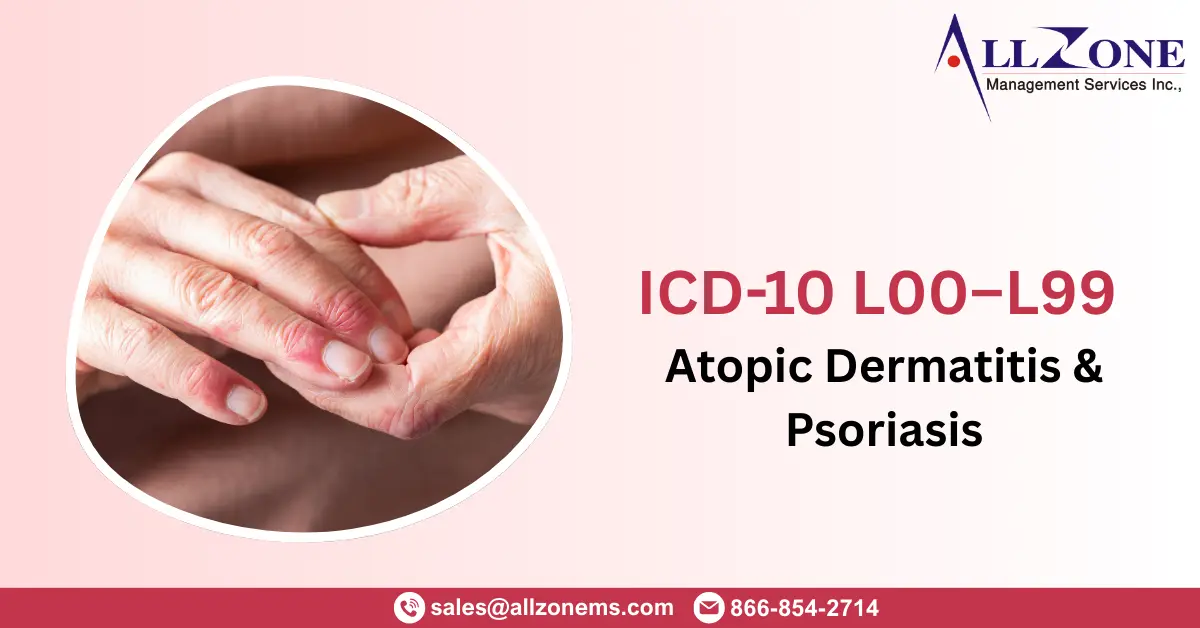
Accurate medical coding plays a crucial role in healthcare documentation, reimbursement, and compliance. Within the ICD-10 classification system, codes L00–L99 cover diseases related to the skin and subcutaneous tissue. These conditions are among the most frequently treated in dermatology practices and primary care settings, making precise coding essential for efficient billing and claims processing.
Two commonly reported conditions in this category are L20 – Atopic Dermatitis and L40 – Psoriasis. Both are chronic inflammatory skin disorders that require proper clinical documentation and accurate ICD-10 coding to ensure appropriate reimbursement and patient care tracking.
This guide explores ICD-10 codes L20 and L40, their clinical relevance, coding considerations, and how healthcare providers can optimize documentation for improved revenue cycle management.
Overview of ICD-10 L00–L99 Skin and Subcutaneous Tissue Disorders
The ICD-10 L00–L99 code range includes a wide variety of dermatological conditions affecting the skin, hair follicles, sweat glands, and underlying tissues. These codes are commonly used by dermatologists, allergists, pediatricians, and primary care providers.
Common categories in this range include:
- Skin infections
- Dermatitis and eczema
- Papulosquamous disorders
- Urticaria and erythema
- Radiation-related skin disorders
- Disorders of skin appendages
Because dermatological conditions often involve chronic management and repeated visits, accurate coding helps providers maintain compliance while maximizing reimbursement.
L20 – Atopic Dermatitis (Eczema)
What is Atopic Dermatitis?
Atopic dermatitis, commonly known as eczema, is a chronic inflammatory skin condition characterized by itching, redness, dryness, and irritation. It often develops in early childhood but can persist into adulthood.
This condition is strongly associated with allergic diseases, including:
- Asthma
- Allergic rhinitis
- Food allergies
Patients typically experience periodic flare-ups triggered by environmental allergens, irritants, stress, or changes in weather.
ICD-10 Code L20 Structure
The ICD-10 code L20 represents Atopic Dermatitis, with several subcategories used for more specific diagnoses.
Common L20 codes include:
| ICD-10 Code | Description |
| L20.0 | Besnier’s prurigo |
| L20.8 | Other atopic dermatitis |
| L20.9 | Atopic dermatitis, unspecified |
Proper code selection depends on clinical documentation, severity, and specific diagnosis recorded in the patient’s medical record.
Clinical Symptoms of Atopic Dermatitis
Patients diagnosed with L20 Atopic Dermatitis may experience:
- Persistent itching (pruritus)
- Dry or cracked skin
- Inflamed or red patches
- Thickened skin from chronic scratching
- Skin infections due to barrier damage
These symptoms frequently occur in areas such as:
- Elbows
- Knees
- Neck
- Hands
- Face (especially in infants)
Coding Best Practices for Atopic Dermatitis
Healthcare providers and medical coders should ensure documentation includes:
✔ Severity of the condition
✔ Location of affected skin areas
✔ Presence of infection or complications
✔ Type of dermatitis diagnosed
Accurate documentation helps prevent claim denials or payer queries, especially when treatment includes prescription medications or specialty dermatology services.
L40 – Psoriasis
Understanding Psoriasis
Psoriasis is a chronic autoimmune condition that accelerates the life cycle of skin cells, causing them to build up rapidly on the surface of the skin. This buildup results in thick, scaly patches, inflammation, and redness.
Psoriasis is not contagious but can significantly impact a patient’s quality of life.
Common triggers include:
- Stress
- Infections
- Skin injuries
- Certain medications
- Cold weather
Psoriasis can affect people of all ages and may also be associated with psoriatic arthritis.
ICD-10 Code L40 Structure
The L40 code category includes several psoriasis types. Some of the commonly used codes are:
| ICD-10 Code | Description |
| L40.0 | Psoriasis vulgaris |
| L40.1 | Generalized pustular psoriasis |
| L40.3 | Pustulosis palmaris et plantaris |
| L40.5 | Arthropathic psoriasis |
| L40.9 | Psoriasis, unspecified |
Each code represents a distinct clinical form of psoriasis, which must be clearly documented for accurate billing.
Common Symptoms of Psoriasis
Patients with L40 Psoriasis may experience:
- Thick red patches of skin
- Silvery scales
- Dry or cracked skin
- Burning or itching sensations
- Nail pitting or thickened nails
- Joint pain in psoriatic arthritis
- The condition frequently affects:
- Scalp
- Elbows
- Knees
- Lower back
- Nails
Because psoriasis often requires long-term management, accurate coding is essential for ongoing treatment claims.
Documentation Tips for Accurate Psoriasis Coding
To avoid coding errors and reimbursement delays, clinical documentation should include:
✔ Specific psoriasis type
✔ Severity level
✔ Body surface area affected
✔ Associated joint involvement (if present)
✔ Treatment type (topical, systemic, biologics)
Clear documentation helps ensure correct assignment of L40 subcategory codes.
Importance of Accurate Dermatology Coding
Coding errors in dermatology claims can lead to:
- Claim denials
- Underpayment
- Compliance risks
- Delayed reimbursements
Because conditions such as atopic dermatitis and psoriasis often require ongoing treatment, proper coding ensures healthcare providers receive accurate payment for services delivered.
Accurate ICD-10 coding also supports:
- Clinical data reporting
- Population health management
- Research and disease tracking
- Healthcare quality initiatives
Common Challenges in Dermatology Medical Coding
Many healthcare practices face challenges when coding skin disorders due to:
- Incomplete Clinical Documentation: Missing details about severity or type can result in unspecified codes.
- Frequent Coding Updates: ICD-10 codes and guidelines evolve regularly, requiring continuous training.
- Complex Payer Requirements: Different insurance companies may have unique documentation expectations.
- High Claim Volumes: Dermatology practices often process a large number of patient visits, increasing the risk of coding errors.
These challenges highlight the need for experienced medical coding specialists.
How Professional Medical Coding Services Help
Outsourcing dermatology coding to experienced professionals can significantly improve practice efficiency.
Professional coding teams help providers:
✔ Ensure accurate ICD-10 code selection
✔ Reduce claim denials
✔ Improve documentation quality
✔ Accelerate reimbursement timelines
✔ Maintain regulatory compliance
By partnering with experts, healthcare providers can focus more on patient care rather than administrative tasks.
Optimize Dermatology Billing with Allzone
Managing dermatology coding, including ICD-10 L20 Atopic Dermatitis and L40 Psoriasis, requires specialized expertise and attention to detail.
Allzone Management Services offers comprehensive medical coding and billing solutions designed to support dermatology practices, hospitals, and healthcare organizations. Our certified coding specialists stay updated with the latest ICD-10 guidelines to ensure accurate claims processing and optimized revenue cycles.
FAQ :
1. What does ICD-10 code L20 represent?
ICD-10 code L20 represents Atopic Dermatitis, a chronic inflammatory skin condition commonly known as eczema.
2. What is ICD-10 code L40 used for?
ICD-10 code L40 is used to classify Psoriasis, an autoimmune skin disease characterized by scaly patches and inflammation.
3. Why is accurate dermatology coding important?
Accurate dermatology coding ensures proper reimbursement, claim approval, compliance with payer rules, and better patient data reporting.
Partner with Allzone today to streamline dermatology coding, reduce claim denials, and improve your revenue cycle performance.
👉 Contact Allzone today to streamline your dermatology coding process.